









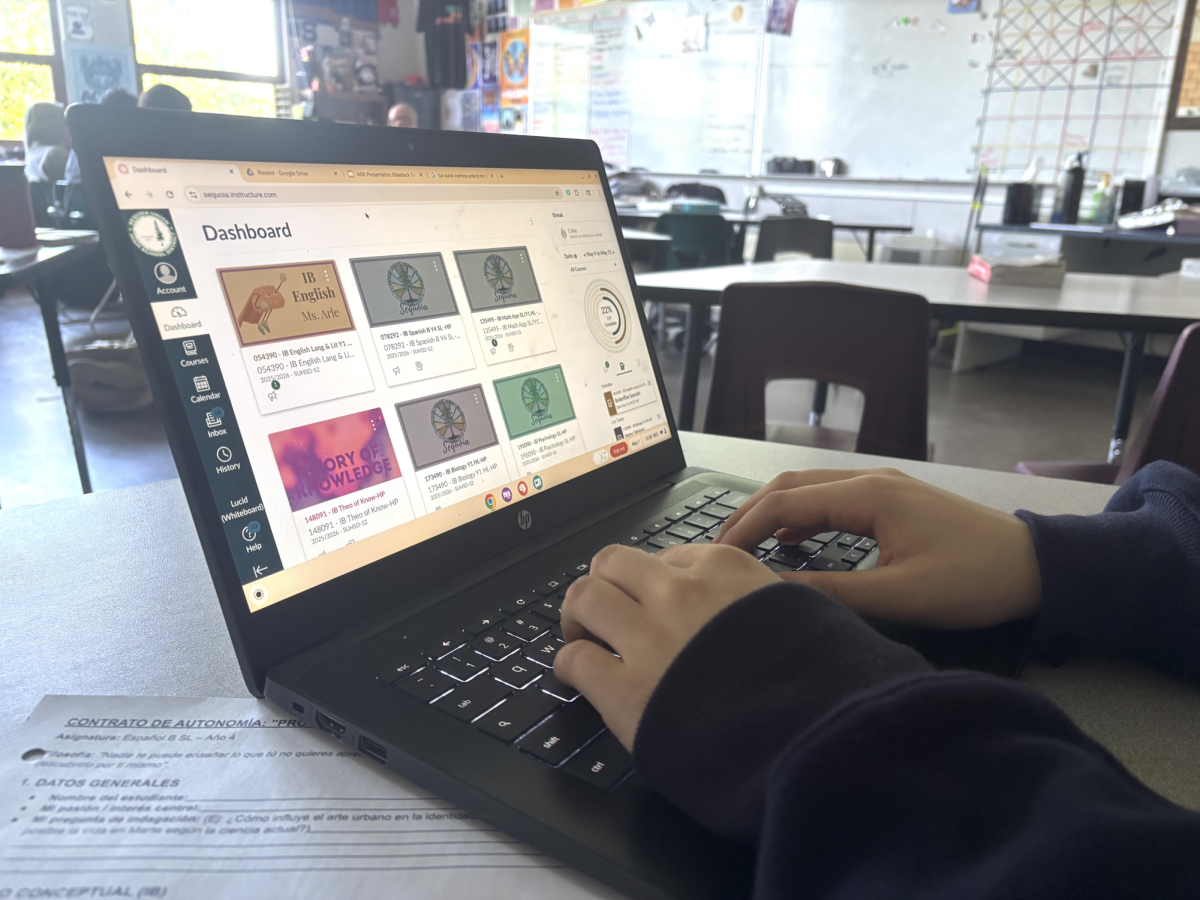
Computers are used daily in Sequoia’s classrooms. Students carry them from class to class and use them for most of their assignments. Sequoia Union High School District first issued individual Chromebooks to all students in the 2018-2019 school year. The goals for having Chromebooks in school were to “Prepare students to be productive, responsible citizens in the Digital Age, increase access to resources, increase oral language development, productivity, and efficiency,” according to the Sequoia Union High School District’s website, but are these goals being accomplished?
Some believe that using technology for learning in classrooms is negatively affecting students’ cognitive abilities.
“I think it is important to consider the effect of heightened screen time on Gen Z’s cognitive capability. We are the first generation to score lower than the previous generation on standardized testing.” Sophomore Sahana James said. “It’s a real concern and it’s not something we should brush off lightly.”
Earlier this year, neuroscientist Dr. Jared Cooney Horvath spoke in a testimony to the U.S. Senate Committee on Commerce, Science, and Transportation. He brought forth the results of various studies saying that Gen Z is less cognitively capable compared to past generations. He also said that Gen Z is the first generation to score lower on a standardized test than the generation before.
Students also cited other problems, including that computers can be very distracting in a learning environment.
“Giving everyone in class access to the internet will lead to people going to other websites and doing different things. The ability to be connected to anyone, anywhere on Earth, will never not be a distraction,” Sophomore Gage Aflak said.
In a 2014 study cited in Horvath’s testimony, students are off task on their computers two-thirds of the time during class. Horvath claims that the ability to access the entire internet easily on computers is part of the reason why educational technology is not working. Task switching is also correlated with weaker memory formation and higher rates of error.
“Individuals rated as high media multitaskers showed poorer attention to cognitive tasks.” Jennifer E. Davis, PhD, said.
“I don’t think too much time on computers is a huge problem at Sequoia yet, but I think using educational technology and computers works better when it’s monitored, because computers are a distraction.” James said.
Many believe that students’ use of educational technology should be better controlled in order to make them critical thinkers in a technological world.
“If teachers and educators believe that computers are the best way to teach something, then I think we should use them.” Aflak said. “But teachers should take [the drawbacks] into account when making lessons for students.”