








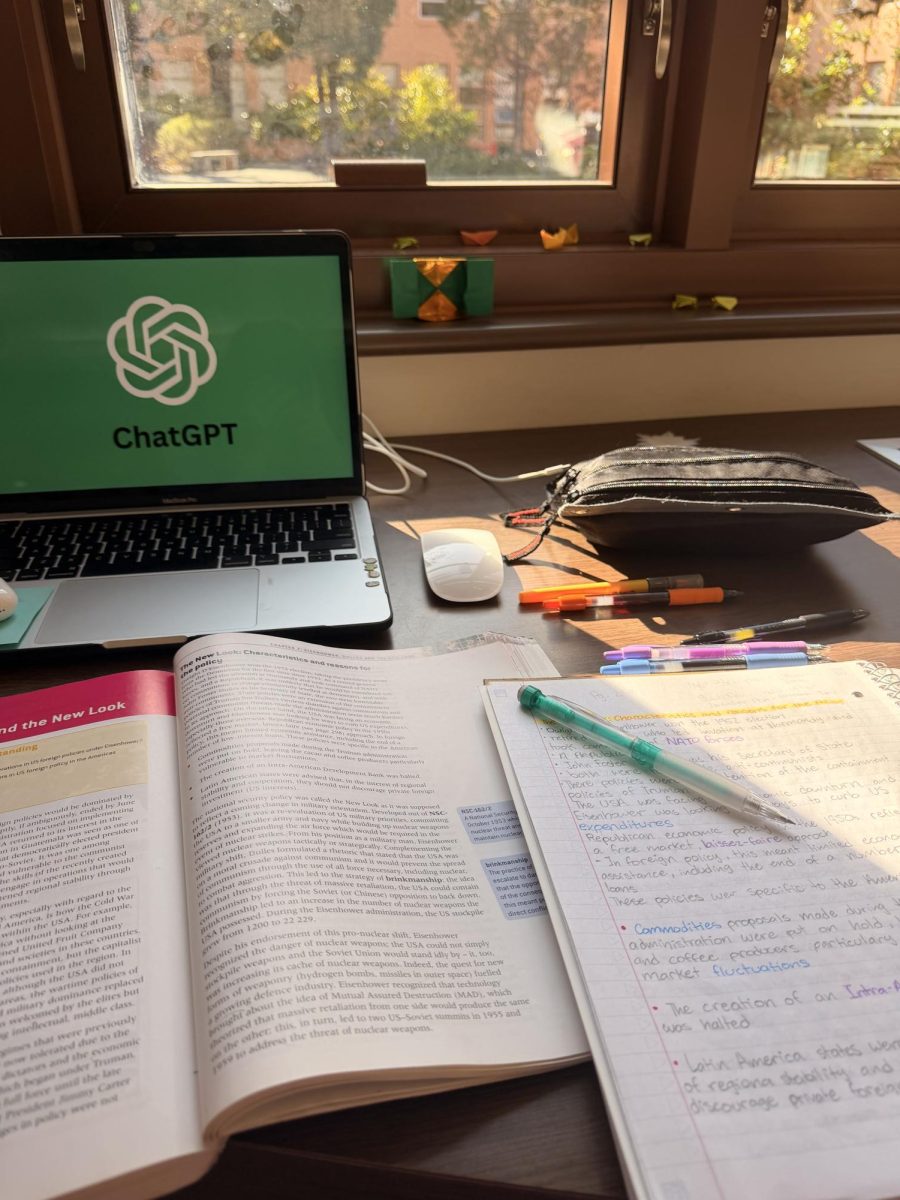
Cheating has always existed in education, but with artificial intelligence (AI) on the rise, the problem has only intensified. AI can now generate study guides and explain complex topics in seconds, reducing what would have been hours of homework into minutes. While these tools can be ethically used to support learning, they are increasingly being misused.
Many rely on AI to do their assignments or even write entire essays, turning simple prompts into cheating scandals. To combat this, schools have turned to AI detection software. One commonly used tool is Pangram Labs, which claims a 99.98% accuracy rate in identifying both AI-generated and human-written text. The software was developed by Max Spero and Bradley Emi, AI researchers from Stanford with professional backgrounds at Google and Tesla.
However, not all software is as reliable. Plagium, for example, has an AI-generated text detection rate of 22%, despite a 100% success rate in identifying human-written work, according to an experiment done by Max Spero, cofounder and CEO of Pangram Labs.
As a result, teachers must navigate a new landscape of academic dishonesty shaped by AI. From implementing detection software to addressing AI misuse in the classroom, educators are working to preserve academic integrity and ensure students’ work remains individual and authentic.
At Sequoia, Turnitin.com is the primary tool used by teachers to detect AI usage in students’ work. The software has both plagiarism detection and an AI monitoring feature.
“Every single paper [is] run through [the software], and if anything comes up, I check exactly what’s being highlighted,” IB english teacher Mrs. Rutigliano said. “Meaning, was the paper submitted [by] another student at Sequoia? Or did the student take large swaths of information from an online source and not cite it?”
Beyond software, teachers also rely on their familiarity with students’ writing styles to identify potential AI use. IB history teacher Ms. Ramroth explained that experience plays a significant role in detection.
“When you’ve been teaching for a while, and you get to know your students’ writing styles, it becomes somewhat easy to determine when a student has written something versus when they have used AI to create their work,” Ramroth said.
This approach seems to be shared by other educators as well. IB history teacher Mr. Bliss emphasizes the importance of long-term observation.
“The primary tool we use is our long-term knowledge of what [high school students’ writing] typically reads or sounds like—which, of course, can vary—and, more importantly, comparing it to previous work,” Bliss said.
Concerns about AI extend beyond educators, with many students believing its misuse is getting out of hand. A recent study conducted by researchers at the Massachusetts Institute of Technology, Wellesley College and the Massachusetts College of Art and Design found that participants who used ChatGPT to write an essay exhibited less brain activity than those who wrote independently. The AI-users also were less likely to recall what they had written and reported feeling less ownership over their work.
Senior Derick Icaza believes that AI has become a serious issue due to its growing presence on social media and rapid technological advancements.
“It’s just an easy way out for students,” Icaza said. “[If] there’s a long assignment, AI could shorten the workload down. So, I guess it’s an [accessible tool] that can help students, but it’s unethical and I don’t use it.”
For teachers, AI misuse raises concerns not only about prevention, but also about student learning and development. Many are questioning just how widespread reliance on AI has become and what it means for education.
“I think it’s a massive problem. Every decision that a student makes to cut a corner, they lose something priceless, which is the opportunity to learn,” english teacher Mr. Wohl said.
As AI use among students becomes common, teachers’ concerns are increasingly raising, especially its impacts on students’ individuality and their education as a whole.
“Brainstorming is part of a natural, comprehensive process that you [should experience cognitively to establish ideas] you want to work on. If you’re having ChatGPT help you do that, I think that’s taking away a large portion of your creativity and your voice,” Rutigliano said.
Beyond creativity, educators emphasize that doing the work independently provides educational value that AI could never replicate.
“If you decide to cut corners, not read the book or try to use AI to read the text, you lose something really, really special, and something that is not achievable through AI,” Wohl said. “AI can compose an essay for you and do an okay job. It sucks that it’s not you, but one thing ChatGPT will never be able to do is read for you. It will never be able to do that.”
Despite these concerns, teachers believe there are ways to reduce students’ reliance on AI while still supporting them academically.
“I think it’s our job as teachers to make the case for why there are situations where students shouldn’t use it, help students develop the skills when they’re learning or frustrated, set reasonable expectations so students don’t feel pressured to cheat and create assignments that are worthy of student time and are somewhat AI-proof,” Ramroth said.