















WARNING: SPOILERS AHEAD
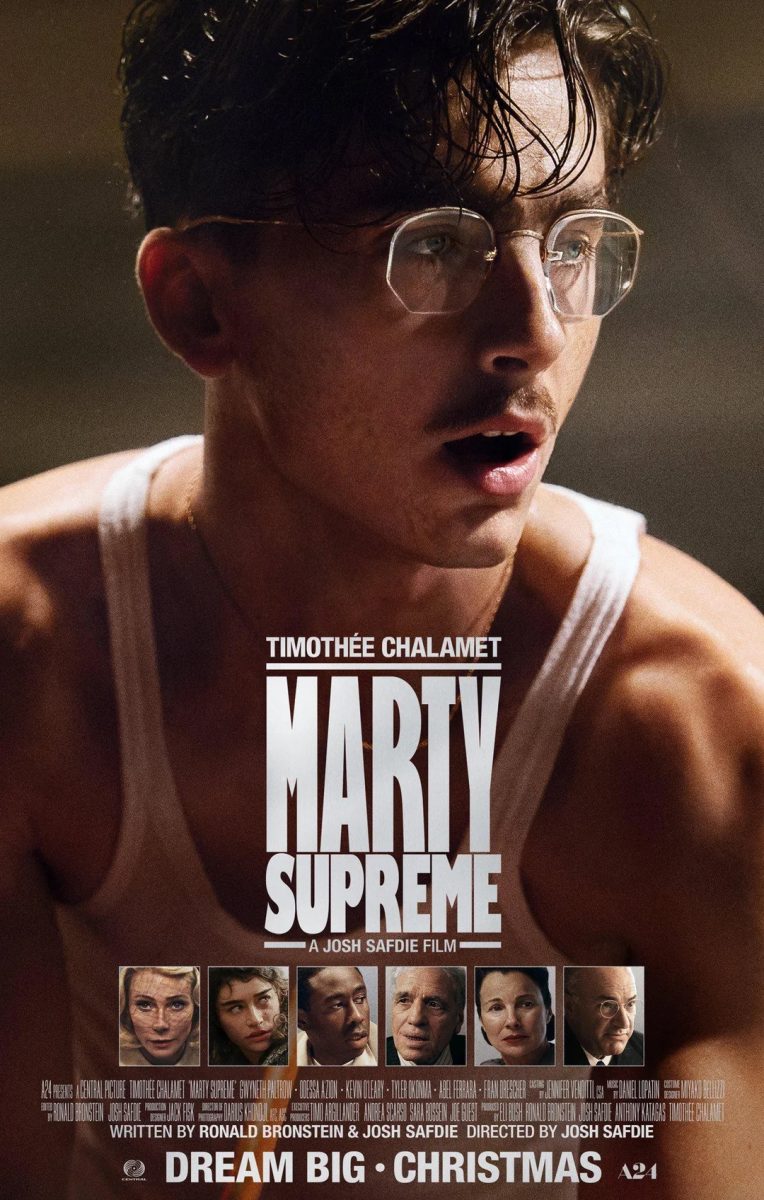
With “Marty Supreme” releasing on Christmas Day, its marketing campaign was impossible to ignore. From celebrities sporting the NAHMIAS x Marty Supreme Warm Up Jacket to an orange blimp hovering over major cities, and even a viral “Zoom meeting,” from the marketing team, it is undeniable that this film’s marketing has gone above and beyond what others have attempted in recent years. However, marketing and hype is one thing; performance is another. The real question is whether the film lives up to the anticipation.
The film loosely follows the life of Marty Reisman, an American table tennis player, and his pursuit of greatness. Timotheé Chalamet stars as Marty Mouser, a fictionalized version of Reisman, who aspires to win the British Open and defeat longtime champion Bela Kletzki, played by Géza Röhrig. After securing a playful, friendly victory over Kletzki, Mouser’s winning streak comes to an end with a loss to Japanese competitor Koto Endo, portrayed by Koto Kawaguchi.
Returning to New York, Mouser navigates his relationship with childhood best friend Rachel Mizler (Odessa A’zion), an affair with Milton Rockwell’s (Kevin O’Leary) movie star wife, Kay Rockwell (Gwyneth Paltrow) and side hustles with his friend, Wally (Tyler, The Creator), all while preparing for the World Championship.
Chalamet’s manic performance as Mouser fully immerses audiences in the mindset of the table tennis star, capturing the overambition that defines every aspect of the film. From Wheaties boxes and orange ping-pong balls to Mouser’s unwavering belief in his own “supremeness,” the character embodies the paradox of the American dream, revealing how greatness and insanity often coexist. Chalamet reinforces this self-assuredness with a performance that reminds audiences why the Hell’s Kitchen-raised actor rose to prominence through films such as “Call Me by Your Name” (2017) and “Dune: Part Two” (2024). His acting feels raw and authentic to the art of film, transforming seemingly outsized marketing promises into something grounded and convincing.
Director Josh Safdie, best known for writing and directing “Good Time” (2017) and “Uncut Gems” (2019), makes his solo directing debut with “Marty Supreme.” Through car chases, table tennis betting and gas station fires, Safdie’s chaotic, fast-paced style mirrors the film’s restless energy, supported by dynamic camerawork from cinematographer Darius Khondji. Safdie’s collaboration with the film’s production is unforgettable, marking a strong and well-earned step forward in his solo directing career.
One of the film’s stand-out elements lives in the music. Although set in the 1950s, the experimental, dance-pop score composed by Daniel Lopatin adds an incandescent spark that mirrors Mouser’s restless energy. The use of classic 1980s hits such as Alphaville’s “Forever Young,” and Tears for Fears’ “Everybody Wants to Rule the World,” brings familiarity and nostalgia to the otherwise electronic soundscape. With notable background vocals from Weyes Blood, the score adds an exciting depth and momentum to the film’s table tennis rush, similar to Lopatin’s critically acclaimed work on “Challengers”(2024).
The soundtrack earned an impressive 8.3 rating from Pitchfork, and Lopatin’s musical contributions give the film a distinct identity, further solidifying “Marty Supreme” in a movie hall-of-fame.
From surprise rap features to ping-pong ball security and orange-outs, “Marty Supreme’s” marketing and film perfectly reflect Marty Reisman’s natural showmanship and high-flying ambition while remaining fully self-sufficient within the fictional story of Marty Mouser. The successful combination of thrill, drama and comedy position the film as a future classic, delivering exactly what it promised in the marketing.
Madison • Jan 15, 2026 at 10:43 am
Wow this is such an amazing review! Emiliana never fails to amaze me!